
Full Funnel Digital Marketing
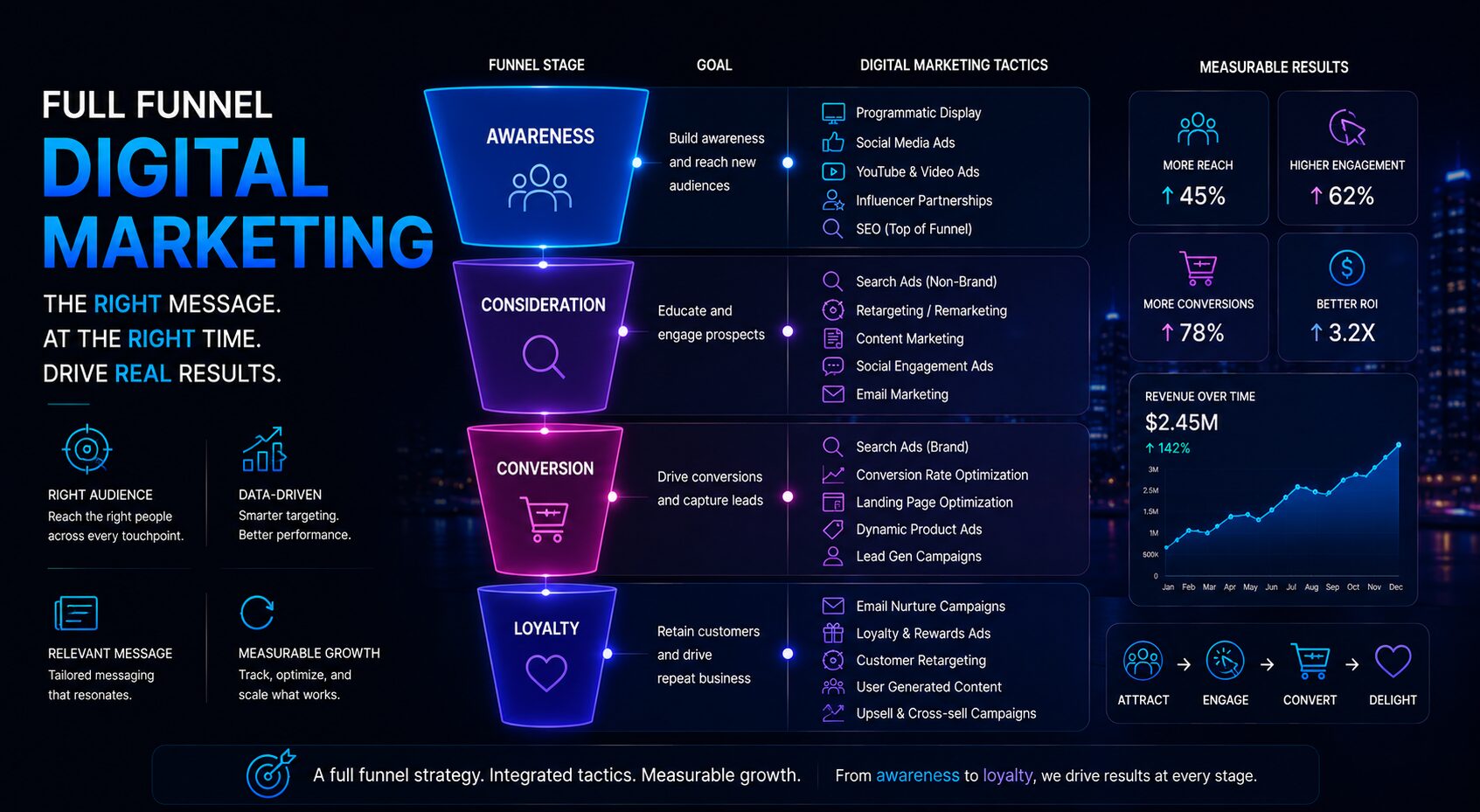
The Full Funnel Explained: Awareness to Conversion Channels
Most marketing fails for one reason. It focuses on a single stage and ignores the rest. A full funnel marketing approach fixes that. It maps the right channels to each stage of the buyer journey, from the first moment of awareness to the final conversion. This guide shows how the pieces fit together.
We help businesses across the US build full funnel programs. Here is how to think about each stage and the channels that serve it.
What the Funnel Really Is
The funnel describes the path a customer takes. At the top, they become aware of a problem or a brand. In the middle, they research and compare. At the bottom, they decide and buy.
Each stage needs different messaging and different channels. A channel that builds awareness rarely closes a sale, and a channel that closes sales cannot reach people who have never heard of you. Full funnel marketing covers all three stages on purpose.
Top of Funnel: Awareness
The top of the funnel is about reach. You want to introduce your brand to people who do not know you yet. The goal is attention, not an immediate sale.
Broad, visual channels work best here. Connected TV and streaming ads on Hulu, Disney, and ESPN put your brand on the big screen. YouTube advertising and video pre-roll reach people while they watch. Even digital out of home billboards build local and regional awareness at scale.
Middle of Funnel: Interest and Consideration
Now people know you exist. The middle of the funnel keeps you in their mind while they research and compare options.
This is where you stay present without being pushy. Programmatic display keeps your brand visible across the sites your prospects visit. Paid social ads and strong social media management build familiarity and trust. Geofencing mobile ads can target people near your location or a competitor’s.
Bottom of Funnel: Conversion
At the bottom, people are ready to act. They are searching for a solution and comparing the final few options. Your job is to be there and make the choice easy.
High-intent channels rule here. Paid search and PPC capture people actively searching to buy. SEO services and local SEO earn the organic clicks for those same searches. And AI search visibility makes sure you appear when buyers ask an AI for a recommendation.
The Owned Channels That Tie It Together
Some channels work across every stage. These are the ones you own, and they cost less per touch than paid media.
Email marketing and text marketing nurture leads from interest to decision and keep customers coming back after the sale. Your website is the hub the entire funnel points toward. Without a strong site, every other channel underperforms.
Why a Single Channel Fails
Picture a business that only runs paid search. It captures people who are already looking, but it never reaches the much larger group who have not started searching yet. Demand stays flat because nothing feeds the top of the funnel.
Now picture the opposite. A business runs only awareness ads but has no conversion channels. People learn the brand exists, then have no clear path to buy. The funnel leaks at the bottom.
Full funnel marketing solves both problems by covering every stage with the right channel.
Building Your Full Funnel Plan
Start by mapping your current channels to the funnel. Where are the gaps? Most businesses are heavy in one stage and thin in others.
Then fill the gaps with channels that match. A full-service partner can run the whole funnel and shift budget between stages as the data comes in. That coordination is the real advantage, because the stages feed each other.
Tailor It to Your Industry
The ideal funnel shape varies by industry. A home services business may need a strong bottom funnel for urgent searches plus local awareness. A professional services firm or education provider often needs a longer middle funnel to nurture a slower decision.
The Takeaway
Full funnel marketing is not about doing everything at once. It is about covering each stage with the channel built for it, then connecting those channels so they reinforce each other. Awareness feeds consideration. Consideration feeds conversion. And owned channels keep it all moving.
Want a funnel that actually connects? Take our quick marketing quiz and we will build one around your goals.
FAQs
What is full funnel marketing?
Full funnel marketing maps channels to each stage of the buyer journey, from awareness at the top to conversion at the bottom. It ensures you reach people before, during, and at the moment of their decision.
Which channels work best for awareness?
Broad, visual channels like connected TV, streaming ads, YouTube, video pre-roll, and digital out of home build awareness by reaching large audiences who may not know your brand yet.
Which channels drive conversions?
High-intent channels like paid search, SEO, local SEO, and AI search visibility capture people who are actively looking to buy and ready to act.
Why is a single-channel strategy risky?
A single channel covers only one funnel stage. You either fail to create new demand or fail to convert it. Covering the full funnel keeps the pipeline flowing.
How do email and text fit the funnel?
Email and text are owned channels that work across stages. They nurture leads through consideration, push them toward a decision, and retain customers after the sale.