
geofencing advertising
Geofencing Advertising: How It Works and When to Use It
Imagine drawing a virtual fence around your competitor’s parking lot. Every phone that crosses into that fence becomes part of your audience. You can send those phones an ad for your business over the next several days, on apps they already use. That is geofencing advertising in one sentence, and it is one of the most precise tools available to local businesses today.
It also works in friendlier places. You can fence your own store, a popular Cherry Hill event, a Marlton trade show, a Camden shopping plaza, or a Haddonfield neighborhood. The audience built from those locations becomes a real, addressable list. To see how we manage it, start with our geofencing mobile ads services.
What Geofencing Advertising Really Is
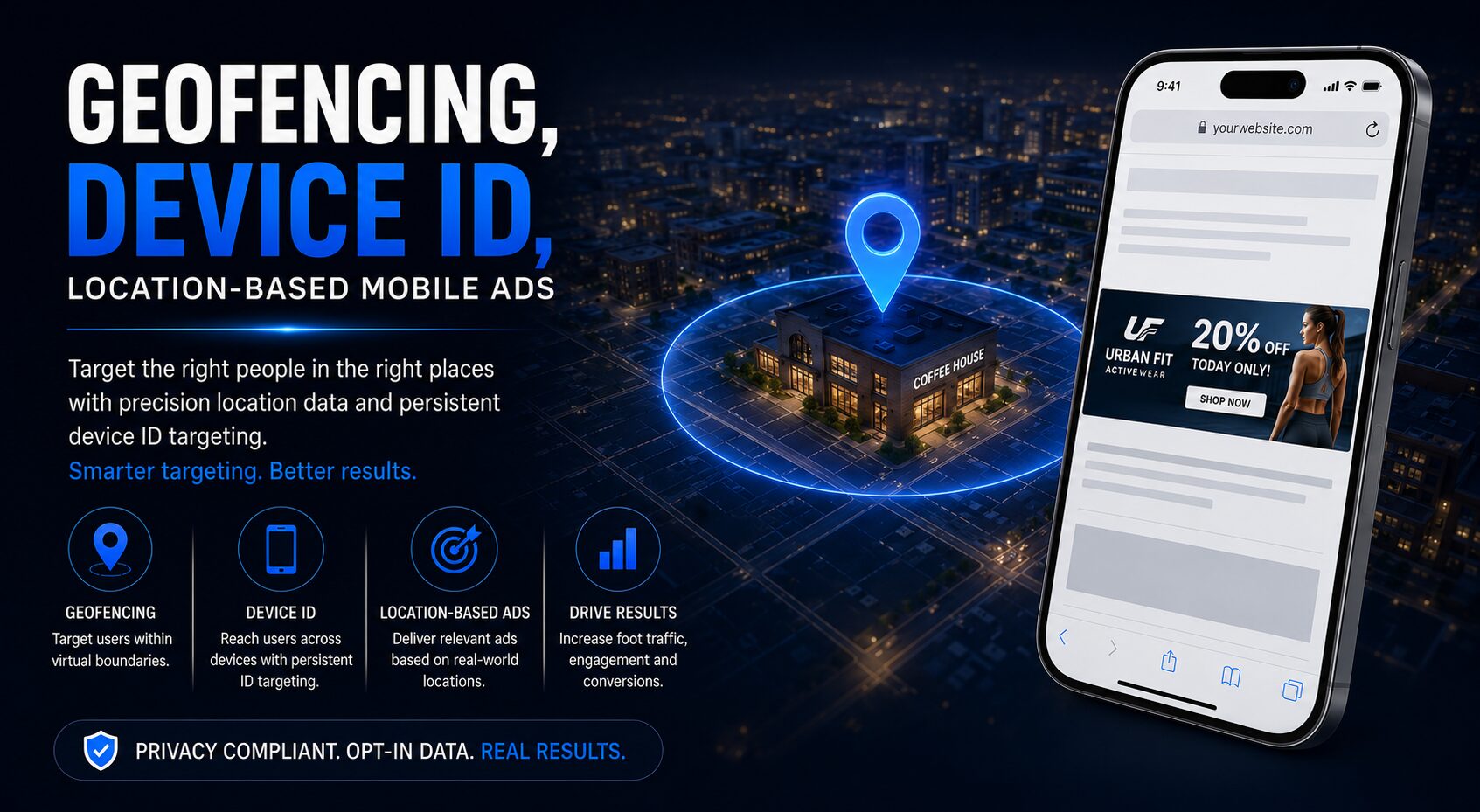
Geofencing advertising is the practice of using GPS or other location signals to define a virtual boundary around a physical place. When a mobile device enters that boundary, the device becomes part of an audience that can later be shown ads. The boundary can be small, like a single building, or larger, like a neighborhood.
The technology relies on signals phones already share. App location data, GPS coordinates, and Wi Fi beacons all play a role. The ad networks combine these inputs to build a clean, opted in audience without ever knowing personal information about any single individual.
Three pieces make it work. First is the fence itself, which defines the location. Second is the dwell time, which decides how long a phone needs to be in the fence to count. Third is the ad window, which sets how long after the visit the audience remains active for ad delivery.
Why Geofencing Advertising Works for Local Businesses
Few channels match its precision. A Camden contractor can target people who recently visited a home improvement store. A Marlton restaurant can reach people who visited any of three nearby competing restaurants in the last thirty days. A Haddonfield boutique can pull a list of people who attended a downtown event.
That precision is the unfair advantage. Most local ad campaigns rely on rough demographics or broad zip codes. Geofencing advertising lets you reach people who have already shown the exact behavior you care about, which is being physically present at a location that signals real intent.
Reach grows quickly too. Once the audience is built, the ads can run on hundreds of apps the visitor uses, from weather to news to games. The phone becomes the gateway. The whole region of South Jersey can be carved into targeted micro audiences in days, not months.
Common Geofencing Use Cases
Three patterns drive most local results. The first is competitor conquesting. A Cherry Hill auto repair shop can fence two competing shops nearby. Anyone who visits either becomes a target for a follow up ad highlighting why a switch is worth considering.
The second is event targeting. A Marlton wedding venue can fence a bridal expo. Anyone who attended becomes a target for engagement ads in the weeks that follow. A Camden home services brand can fence a home and garden show with similar effect.
The third is neighborhood and route targeting. A Haddonfield medical practice can fence a tight radius of high value zip codes. A commuter route along Route 38 or the AC Expressway can be fenced to reach drivers who pass a specific area daily. Use these patterns alongside digital out of home advertising to combine billboard and phone exposure in the same window. The matched digital out of home advertising guide walks through the screen side of that combo.
How a Geofencing Campaign Comes Together
Strong campaigns follow a clear sequence. Start with a single goal. Foot traffic, online conversions, and brand awareness each call for a different setup, so pick one outcome that matters most.
Next, choose the locations. List the South Jersey places where your future customers already go. That might include competitor businesses, complementary venues, events, or specific neighborhoods. The list should be tight. Twenty well chosen fences usually beat one hundred random ones.
Then build the ads. Mobile geofencing typically uses small banner or video formats that load fast on phones. Keep the message simple and the call to action obvious. A click to call button or a map link works well for local businesses.
Finally, set the dwell and retargeting windows. Most campaigns use a dwell time of three to five minutes and a retargeting window of fifteen to thirty days. Adjust based on the type of location. For deeper layering, pair geofencing with paid social ads and connected TV advertising so the same audience meets your brand across phone, social, and TV. The matched what is connected TV advertising guide explains the TV side.
Measuring Geofencing Advertising
The reports run deeper than most channels. Standard metrics include impressions, clicks, and click through rate. Location specific metrics include visits per fence, dwell times, and how often a phone returned to your business after seeing an ad.
That last one matters most. Foot traffic lift, often called walk in attribution, ties an ad exposure to a real visit. A Cherry Hill or Haddonfield retailer can see whether the people who saw the ad actually came in. That measurement was nearly impossible before geofencing matured. To see how the same discipline plays out across other channels, browse our client results.
Review monthly. Trim weak fences, scale strong ones, and refresh creative every six to eight weeks.
Compliance and Best Practices
Geofencing relies on location data, which makes responsible use important. Reputable platforms follow strict privacy rules and only use anonymized signals from users who have opted in to location sharing on their devices.
Use the channel for ads, not surveillance. Avoid fencing locations that imply sensitive activity, such as places of worship or medical facilities, unless your business has a clear and appropriate reason. Stay close to platform guidelines and you will run a clean, effective program.
The industries we serve all run inside compliant geofencing setups, with audience sizes and targeting designed for steady, ethical results.
When Geofencing Is Not the Right Fit
A few scenarios call for other tactics. National brands with no physical service area get less out of geofencing. So do businesses that close all sales online with no physical follow up.
Geofencing also struggles when the fence is too small or too sparse. A single store with low daily foot traffic may not generate enough audience to justify the channel. In those cases a wider geographic radius or a different channel inside our full marketing services mix may be a better fit.
Frequently Asked Questions
What is geofencing advertising?
Geofencing advertising is a location based advertising tactic that uses GPS or similar signals to draw a virtual boundary around a physical place. Phones that enter the boundary become part of an audience that can be shown ads later. It works well for competitor targeting, event marketing, and neighborhood campaigns across Cherry Hill, Marlton, Camden, and Haddonfield.
How accurate is geofencing?
Modern geofencing can target locations down to a city block, with practical accuracy of about thirty to fifty feet outdoors. Indoor accuracy varies based on the building and signal availability. For most local business goals the accuracy is more than enough.
How much does geofencing advertising cost?
Most local campaigns launch with modest monthly budgets. The total spend depends on the number of fences, audience size, and creative variants. A planning conversation usually returns a clear number tied to specific South Jersey goals.
Is geofencing legal and ethical?
Yes, when run on reputable platforms that follow privacy rules. The technology uses anonymized location signals from users who have opted in to location sharing. Avoid sensitive locations and use the channel for ads, not surveillance.
When should I use geofencing advertising?
Use it when your business benefits from physical visits or local intent signals, such as competitor targeting, event follow up, or neighborhood focused campaigns. It works especially well for retail, home services, restaurants, medical practices, and event venues across Cherry Hill, Marlton, Camden, and Haddonfield.
Ready to Draw Your First Fence?
The phones that matter are already walking past your competitors today. Let us turn them into your customers. Book a free geofencing consultation and we will design a geofencing advertising plan built for your South Jersey market.